

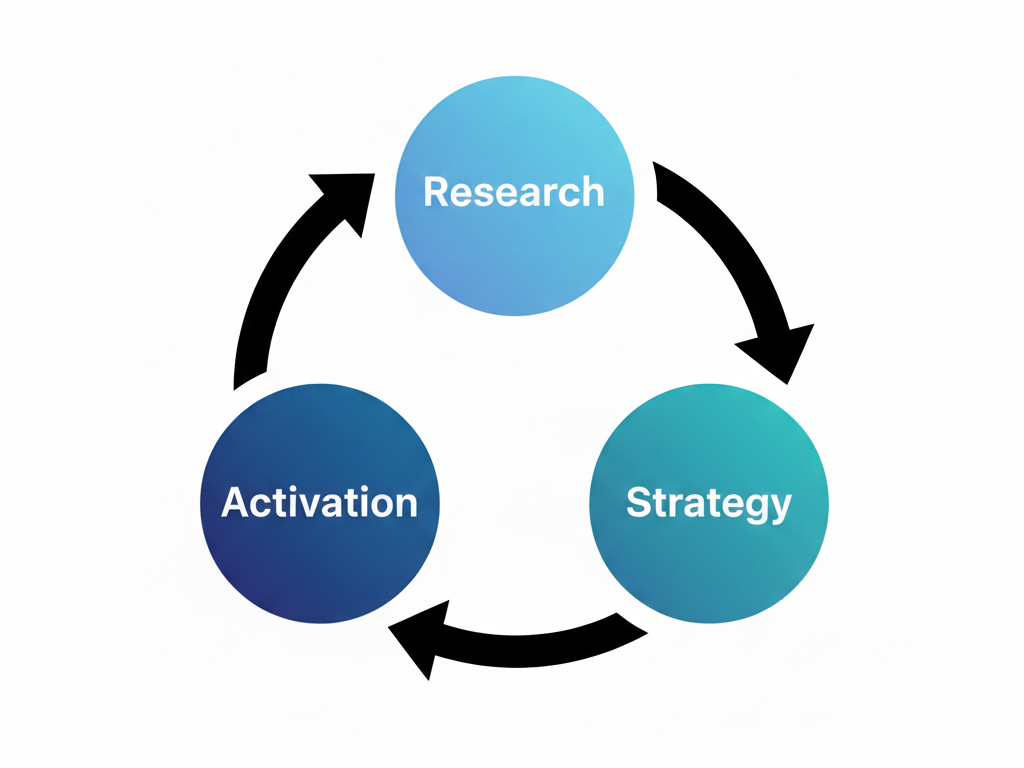
Product Marketing is one of the most misunderstood roles in tech. Ask five people what it means and you will get five different answers. From my time at various start-ups in Silicon Valley, I’ve come to see the function in three core pillars: Research, Strategy, and Activation.
1. Research
This is where it all begins: getting close to customers, uncovering what keeps them up at night, and mapping the competitive landscape.
At Ripple, I spent countless hours gathering insights from payment providers and financial institutions across different regions. At Affirm, research meant testing different value propositions with existing customers to see what truly resonated. At Modern Treasury, it involved listening closely to Gong calls with prospects and customers to surface recurring pain points. This work is often fascinating, but it can also be tedious (let’s be real).
Where AI helps:
- Customer insights at scale:
- Instead of manually combing through survey responses, support tickets, or reviews, AI can group thousands of data points into clear themes.
- Competitive scans:
- No more juggling 20 browser tabs. AI can quickly summarize competitor websites, press releases, and product reviews.
- Market signals:
- From regulatory updates to trend reports to company specific updates, AI can surface early signals of change so you do not miss opportunities. Alerts can also keep you updated automatically.
At Ripple, synthesizing customer insights across APAC, LATAM, and EMEA could take weeks. Today, AI could compress that effort into days.
2. Strategy
Once you know the lay of the land, the real work begins: turning insights into messaging, positioning, and sometimes pricing and packaging. Strategy is about distilling all that complexity into something simple, clear, and compelling.
At Modern Treasury, for example, we built a positioning framework for our ledger product. The insight was simple: developers hated building and maintaining ledgers (it’s actually one of the hardest problems in engineering). The strategy was to position Modern Treasury as the tool that removed that burden so teams could 1). free up engineering resources to focus on other projects and 2). accelerate time to market.
Where AI helps:
- Messaging drafts:
- AI can generate first-pass versions of positioning statements or value props that you can refine. It is often easier to start with something rough than with a blank page.
- Persona building:
- By analyzing win-loss data and customer behavior, AI can paint a more complete picture of your buyer.
- Scenario testing:
- Curious how a new pricing model might land? AI can model adoption curves and price elasticity, highlighting trade-offs. A mix of AI/ML modeling platforms, analytics tools, and specialized pricing software would support this type of work.
Ultimately, AI gives PMMs a valuable head start, creating more space to pressure-test messaging, personas, and scenarios.
3. Activation
This is the fun part: taking the strategy and turning it into market impact. Product launches, campaigns, enablement, adoption. Activation is where the rubber meets the road.
At Ripple, activation meant enabling global sales teams to sell digital asset solutions in a consistent way across dozens of markets. At Affirm, it meant orchestrating campaigns with large retail partners to drive consumer adoption. At Modern Treasury, it meant managing cross-functional product launches that drove adoption among developers and CFOs alike.
Where AI helps:
- Campaign assets:
- AI can accelerate the creation of emails, landing pages, and blog posts tailored to different audiences.
- Sales enablement:
- Copilots can arm Sales with real-time talk tracks, objection handling, and personalized follow-up notes.
- Performance analysis:
- AI can unify data from tools like Salesforce, HubSpot, and ad platforms, spot patterns, and highlight what matters most. It can flag anomalies, show which channels drive pipeline, and even forecast performance.
At Modern Treasury, every launch required building enablement decks, messaging docs, and campaign plans. With AI, much of that work can be automated, giving teams a solid starting point to refine and build on.
Final Thought
AI does not change the core of what Product Marketers do. It simply makes the work lighter and faster. By helping us get smarter in research, sharper in strategy, and quicker in activation, AI frees us up to focus on what really matters: building stories that resonate, products that people love, and growth that lasts.
Having lived this across Ripple, Affirm, and Modern Treasury, I see AI not as a replacement but as a multiplier. It allows PMMs to scale with the market, stay true to customer needs, and unlock momentum and revenue.




 Did AI Do That?
Leave a comment